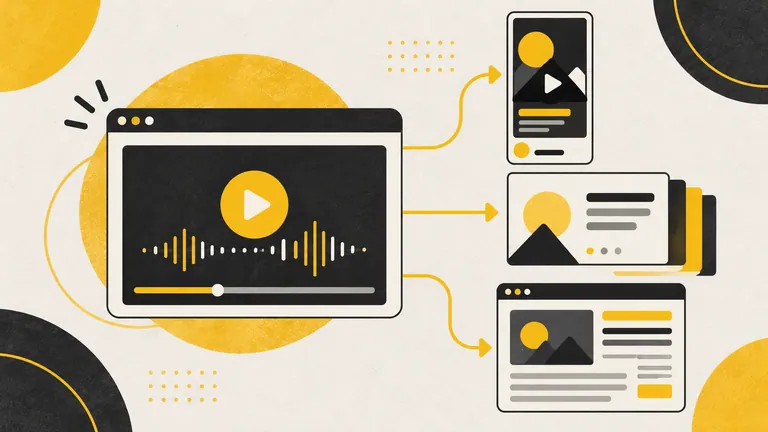
Producing a webinar takes expert time, preparation and promotion. After the broadcast, the recording often remains available, but some of the knowledge presented can still be useful to people who did not attend. Editorial repurposing turns that material into content with distinct purposes.
For a B2B company, the decision should account for the quality of the original content, its relevance today and the work required to adapt it. A long recording may yield only a few useful pieces. A short, well-supported passage may provide an explanation that was missing from the website or social channels.
This guide explains how to select material, preserve the meaning of speakers' remarks and organize production around the team's capacity. The method also applies to recorded interviews and technical presentations.
When repurposing a webinar is worthwhile
Start with the value of the information after the event. Does it explain a recurring problem? Provide criteria for a decision? Offer a demonstration or analysis the company can support? These qualities help identify content with a purpose beyond the broadcast.
In its guidance on repurposing content, published on May 17, 2024, LinkedIn describes adapting existing materials for new uses and audiences, including excerpts from long videos. Applying that idea requires choosing what each new piece delivers on its own.
Before starting, confirm:
- Is the topic still relevant to potential clients?
- Are the information and references still accurate?
- Do the audio and image quality support a clear edit?
- Can the company reuse the recording, images and materials presented?
- Is someone available to validate the technical interpretation?
- Does the subject complement the calendar and existing content?
An event focused on circumstances that have changed may require extensive updating. In that situation, producing a new explanation may be more appropriate than recovering the recording. Document that decision before committing editing hours.
Build an editorial foundation before requesting clips
Gather the recording, presentation, references and a transcript that can be reviewed. Use the transcript to locate arguments; names, figures, acronyms and technical terms need to be checked against the audio and sources. Do not treat an automated transcript as an approved version.
Create a record for each candidate passage, including its start and end timestamps, the question answered, the central idea, necessary qualifications and the reference used. Add the intended audience and the action the content should help them take.
This record helps avoid choosing only striking statements. A passage that sounds persuasive may depend on a condition explained several minutes earlier. Without that condition, an edit can turn a possibility into a general recommendation.
Our article on customer questions as B2B content topics helps assess which questions deserve attention. In repurposing, the next task is to establish whether the recording actually answers them.
Give each format a purpose
A short video to clarify a specific decision
Select a passage that communicates an understandable idea with a beginning, development and conclusion. It might be a comparison, an explanation of a common mistake or a selection criterion. If the answer depends on a chart, preserve that visual information or adapt the presentation so it remains readable.
Length should reflect the explanation required and the selected channel. Shortening a statement by removing the condition that limits its application undermines its usefulness. In some cases, recording a new, focused explanation with the specialist will be more efficient than trying to repair an incomplete clip.
A carousel to organize a sequence
Use a carousel when the material contains steps, comparable criteria or reasoning that benefits from progressive reading. Define each slide's message and remove references that only make sense during the event, such as “as we saw on the previous slide.”
A carousel can summarize a process, but it needs to retain relevant conditions. If guidance depends on company size or data availability, that information should accompany the recommendation.
An article to develop the explanation
An article lets the team reorganize material for reading, add definitions and verify references. The opening should introduce the reader's question without depending on the webinar's chronology. Repeated statements and event interactions can be removed when they do not contribute to the answer.
In its helpful content guidance, Google emphasizes original information, analysis and value for the audience. When adapting a recording, add the context needed for the text to function as a complete resource with clear authorship and sources.
If an existing article already serves the same intent, consider updating it as a separate editorial project. Publishing another page with a nearly identical promise can scatter the information. Our comparison of blogs and social media helps define each channel's role.
A hypothetical example: one explanation, three different uses
Imagine a technology company's webinar about preparing for systems integration. This is an illustrative example, not a Leads client case study or result.
A specialist explains that integration depends on the quality of existing records, clearly assigned responsibilities and the technical capabilities of the systems involved. The team could select:
- A short video: why record quality should be checked before the project starts, preserving the qualification about differences between environments.
- A carousel: what information to gather for an initial assessment, arranged in a sequence a decision-maker can consult later.
- An article: how to organize preparation, explaining responsibilities, dependencies and limitations with current references.
Each piece addresses a different need. The team can publish just one if that is the best use of the budget. The number of formats should follow usefulness and review capacity, without an artificial target of extracting many posts from every recording.
Review context, accessibility and timeliness
Technical review should compare the adaptation with its source. Check that figures retain their units, periods and comparison bases; that a hypothesis remains identified as a hypothesis; and that the edit preserves the statement's conditions. Have the subject specialist review the piece when it involves expert interpretation.
For accessibility review, the W3C guidance on captions for prerecorded video explains that captions include speech and relevant sound information, synchronized with the media. Review names, terminology and display timing; automatic generation requires checking. Captions should also avoid obscuring important visual elements.
For visual materials, check text size and contrast on the screen where they will be consumed. A presentation that is readable on a monitor may need redesigning for vertical video. Make that assessment before completing every piece.
If information has changed since the event, update the adaptation and make the reference date clear when it matters. Avoid presenting an old excerpt as commentary on a new development the speaker did not analyze.
Plan distribution and the next step
Build the calendar around topics and purposes. Avoid repeating the same argument in several closely spaced pieces simply because the files were completed together. One post can introduce the problem; another, at an appropriate time, can explore a criterion that attracted interest.
Choose a relevant destination. A video can lead to the full explanation; an article can introduce a related service when that helps readers evaluate their needs. Our guide to internal links between blogs and services explains how to build those connections.
Evaluate the effort and outcome of each use
Record the hours spent selecting, writing, editing and reviewing. Repurposing requires work, and its cost does not disappear because the recording already exists. Compare that effort with producing a new resource of similar quality.
Define indicators based on purpose: video consumption, relevant interactions about the topic, visits to the full resource and inquiries related to the service. Use each channel's available data with its own definitions. Views across platforms do not necessarily represent the same type of consumption.
Do not add up the reach of the pieces as though every record represented a different person. Do not attribute a new contract to repurposing simply because it followed publication. Data can guide the next batch; commercial outcomes require analysis of the journey and measurement limitations.
A checklist for approving production
- Is the original content still accurate and useful?
- Does each piece have its own question and purpose?
- Have technical qualifications been preserved?
- Have references and reuse permissions been checked?
- Have captions and visual elements been reviewed?
- Does the calendar avoid repeating arguments?
- Are the destination and indicators defined?
- Does the work fit the team's capacity?
Leads to Growth's marketing planning service organizes priorities, channels and execution capacity. Our SEO and content service can help turn company expertise into useful resources connected to search needs. Request an assessment to evaluate which existing materials deserve adaptation and how to integrate them into your plan.